The Riviera riverfront villa plots
Ready to build plots on NH-66, the Mumbai-Goa Highway

The Riviera

India's Rarest Riverfront Address.

  • Only on this land
  • Kankavli, Dist. Sindhudurg, Maharashtra
  • 20 River-Touching Villa Plots | Second Homes

Welcome to The Riviera. Twenty river-touching villa plots on the banks of the Gad river, with clear freehold title, all approvals in place, and nothing standing between you and building your home. Mountains behind you, forest around you, a river at your doorstep. Just 20 plots. When they are gone, they are gone forever.

Download the brochure
Only 1% of India's land is riverfront
Rare

Only 1% of India's land is riverfront. Of that, just a fraction is available to own. And the market has always paid a premium for water across luxury real estate. Waterfront homes consistently command higher prices than comparable inland properties because the view, the exclusivity and the finite supply cannot be replicated anywhere else. Everything inside a home can be upgraded. Water at your doorstep cannot be added later. That is why it keeps appreciating, because no one can create more of it.

The premium the market pays for water

+15%Conservative premium
+25%Typical premium
+40%Exceptional waterfront premium
Sources: SOBHA, Rustomjee and market reports (2025-26); Square Yards; SRFDCL/GharPe. Indicative of the category, not a guarantee of returns.
India's most exclusive riverfront address
Exclusive

Own at The Riviera, and you own one of the rarest addresses in India - riverfront land on NH-66, the Mumbai-Goa Highway. Twenty plots. Not one more. Every one of them ready to build the day you take possession, with clear freehold title, every approval in place, no waiting. Every one of them planned so the river stays in your view, uninterrupted, from the moment you wake up. And every one of them comes with private port access, because the Gad is not a river to look at. It is a river to use. Step onto your boat and Konkan opens up: beaches, forts, coastal villages, all reachable straight from your doorstep. That is what this address gives you. Not a view of the river. A life on it.

The Riviera boat ride The Riviera kayaking The Riviera clubhouse
Sindhudurg is India's next tourism hotspot
Growth

Sindhudurg is moving from Konkan's hidden treasure to India's next tourism hotspot - an underwater museum, a world-class scuba diving centre, a 305-acre film city, and the Mumbai-Goa coastal highway, all underway. Goa, Alibaug and Lonavala were once undiscovered too. Early investors rode that growth curve. Sindhudurg is next, and The Riviera puts you here before the world arrives.

Discover what makes The Riviera one of India's rarest addresses
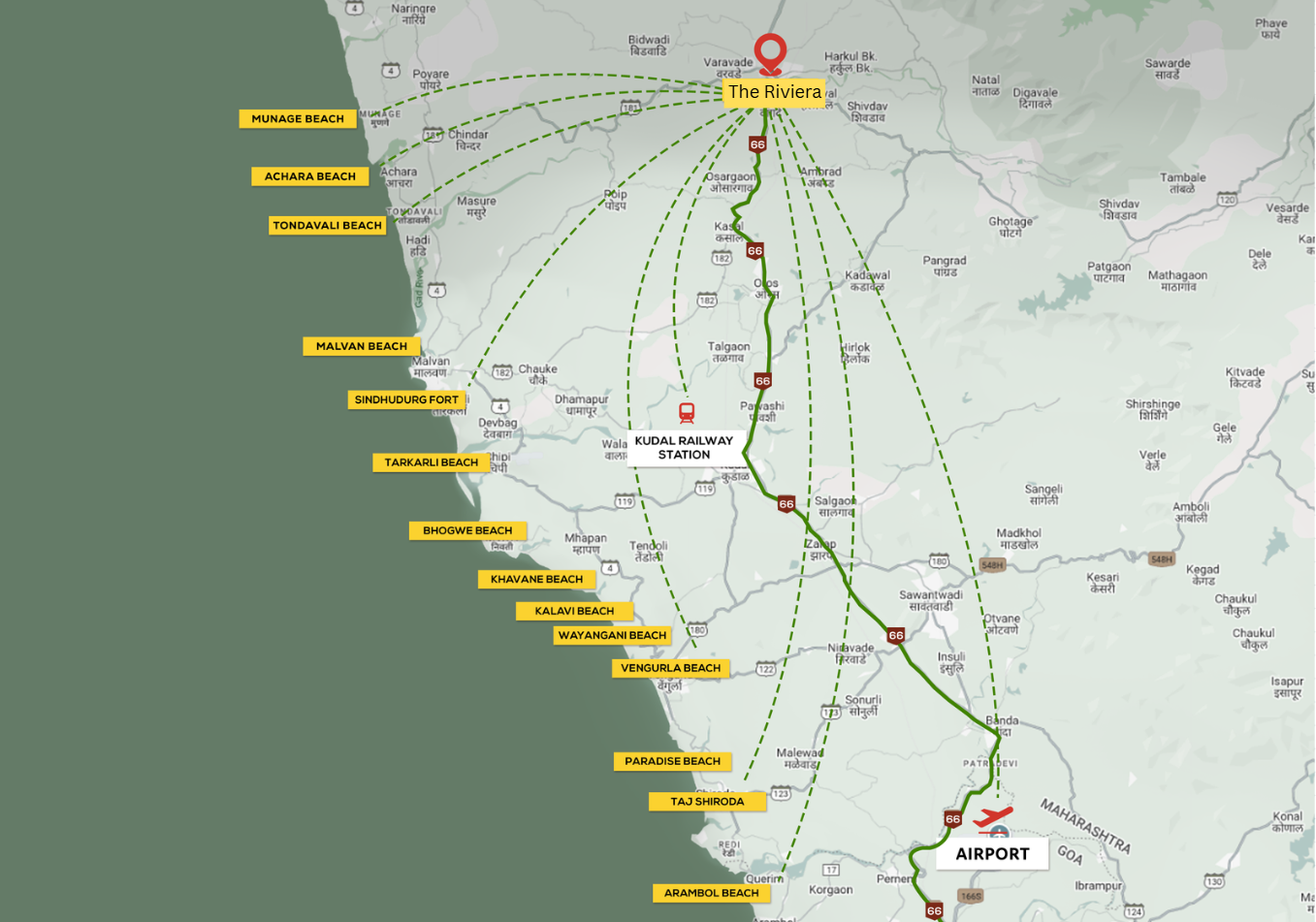
The Riviera location map
Explore the area around The Riviera

Location advantage

The Riviera places you minutes from Goa while keeping you immersed in the untouched beauty of Konkan. Fast connectivity today. And with the Mumbai-Goa coastal highway, the Shaktipeeth expressway, a 305-acre film city and Sindhudurg's tourism push all underway, this is a location that only gets better tomorrow.

On NH 66 (Mumbai-Goa Highway) 50 min - Sindhudurg Airport 45 min - Beaches 50 min - Sindhudurg Fort 75 min - Mopa Airport

Answers to frequently asked questions about The Riviera

The fundamental list of property documents that an NRI needs while purchasing property in India are:

  • Title Deed (in the name of the seller)
  • Sanctioned Building Plan
  • Commencement Certificate
  • Occupancy Certificate
  • Tax Paid Receipts
  • Encumbrance Certificate
  • Khata/Mutation Documents

Below is the list of documents an NRI needs while purchasing or investing property in India:

  1. PIO/OCI Card

    • An NRI requires an Indian passport to invest in property in India. In the event that he/she is an individual who is not a citizen of Pakistan, Nepal, Sri Lanka, Bangladesh, China, Afghanistan, Iran, and Bhutan but had owned an Indian passport, he/she would need a PIO card.
    • An individual would also require a PIO card if he/she is a foreign citizen whose father or grandfather was a citizen of India.
  2. PAN Card

    It is crucial for NRIs to have a PAN card because they will be required to file income tax returns if they have rented out property. Besides, in case the property is sold later, the capital gains resulting from the sales would be subject to capital gains tax. Capital gains would be included in the total income while it is being taxed.

  3. Registered Power of Attorney

    If you are an NRI and don't visit India frequently, it is much more convenient to execute the sale, registration, possession, and other processes by granting a special power of attorney to someone in the city where you are buying a property.

  4. Proof of Address

    If you are an NRI, you need to submit the address proof of your current residence attested by the Indian Embassy in your country of residence.

Yes, NRIs can apply for home loan from any approved banking partner of the project. They can also apply loan from other banks.

If you are a salaried NRI and considering applying for a home loan, you would need the following sets of documents:

  • Two passport size photographs
  • Address proof of the applicant and co-applicant (attested by the Indian Embassy in your country of residence)
  • Address proof (utility bills or driving license would count as address proof).
  • Last 6 months' bank statement of your NRE/NRO account in India
  • Last 6 months' bank statement of your account held in the country in which you work or your salary is credited
  • Salary slip
  • Loan sanction letter copies received in India and abroad
  • Self-declared residential status
  • Power of Attorney to be executed in the format given by the bank and attested from Indian embassy.

  • An NRI can inherit any immovable property in India, whether it is residential or commercial - and even agricultural land or a farmhouse (which they are otherwise not eligible to purchase). An NRI is also free to inherit property from another NRI or resident of India.
  • However, the RBI's permission is necessary if the property is inherited by a citizen of a foreign state and the individual resides outside India.

There is no restriction on NRIs for repatriating rental income or even property sale proceeds (except agricultural land, a farmhouse and plantation property) as long as the total proceeds are within the stipulated limit of $1 million in a fiscal year.

The conditions for availing this facility are:

  • The property being sold was acquired as per the foreign exchange regulations applicable during that period.
  • The amount being repatriated cannot exceed the cost of the sale proceeds.
  • The sale proceeds from a maximum of two residential properties can be repatriated.
  • The maximum amount of repatriated funds from a Non-Resident Ordinary (NRO) account is capped at $1 million per fiscal year.
  • Funds can be repatriated only after settling all the applicable taxes and other charges.

If the property was purchased with money received from inward remittance or debit to NRE/FCNR/NRO account, the entire principal amount can be repatriated outside India immediately while the balance must be deposited in an NRO account.

To start the repatriation process, the NRI must get a certificate from a chartered accountant in India, issued in a form called 'Form 15CB' available on the income tax website of India. Submission of this form confirms that the money acquired was via legal channels and all outstanding taxes have been cleared. The CA verifies and signs the form.

The next step is to fill another form called 'Form 15CA' which can also be downloaded from the same website. The form must be filled and submitted online, The NRI must print out the filled undertaking of Form 15CA displaying the system-generated acknowledgement number and sign it.

To complete the process, the signed undertaking along with the CA certificate on Form 15CB needs to be taken to the bank where one has an NRO account. The concerned bank will check the forms and transfer the money abroad (up to $1 million in an FY). Apart from these forms, the bank will also ask for a copy of the sale document of the property. If the property has been inherited, the bank will ask for the copy of the Will , legal heir certificate, and death certificate of the person on whose demise the property was inherited.


It is obviously very important for an NRI to pay attention to factors like the legitimacy of land, compliances to be followed during construction, environmental clearances, among other considerations, at the time of purchasing property. Given that real estate is a state subject, laws may differ from state to state and there is, therefore, no universally applicable response.

To get clarity on the status of a project, NRIs should preferably consult a lawyer to examine all the legal documents and verify their authenticity. In addition to common concerns, a major factor that they need to look into is whether the project is registered under the respective state RERA and whether it is fully RERA-compliant. However, due to the absence of an operational RERA website in many states & UTs, touching base with a reputed real estate consultancy can help save time and effort, and ensure that everything is in order.

It is not recommended for NRIs to file property dispute cases anywhere other than the jurisdiction where the property is located. This is because only the court in that particular jurisdiction can try a property-related case.

Delays in the construction process beyond the extension period mentioned in the agreement fall within the purview of 'deficiency in rendering of service' under the Consumer Protection Act of 1986 if the project is not registered under state RERA. Such cases are tried by the consumer courts. On the other hand, if the project is registered under RERA, buyers can lodge a complaint against the builder under Section 31 of the regulation with the relevant regulatory authority within the respective state.

In cases of transactions wherein the individual selling the property to an NRI is a resident Indian, TAN number is not required. However, it is needed in case the property is purchased from a Non-resident Indian.

PAN Card is not required for an NRI as they are non-resident Indians with Indian passports; this is applicable particularly if they do not intend to invest money into any business in India. However, it is mandated by the government to own a PAN Card if:

  • An NRI is interested in investing in mutual funds in India.
  • The NRI wants to transfer the funds received from the property transactions in India to their NRE or NRO accounts.
  • They have a source of income in India that is taxable; for example, a rented property